
In spring 1938, the Nazi government inaugurated “Aktion Arbeitscheu Reich” (Operation Work-shy): calling for mass arrests of people deemed by the regime to be “asocial,” a broad category that included vagrants, mendicants, alcoholics, Sinti and Roma, and, often, gays. The campaign began in April and later morphed into an operation called the “Juni-Aktion” (June Operation) that targeted Jews. An estimated 2,300 to 2,500 men were arrested and sent to various concentration camps. Among them was Fredy Lewin, who was interned in Buchenwald on June 15, 1938. We know just a little about Fredy from items contained in a larger collection of material donated by cousins, as well as from papers found in the Arolsen Archives, the world’s largest archive on victims and survivors of Nazi persecution.
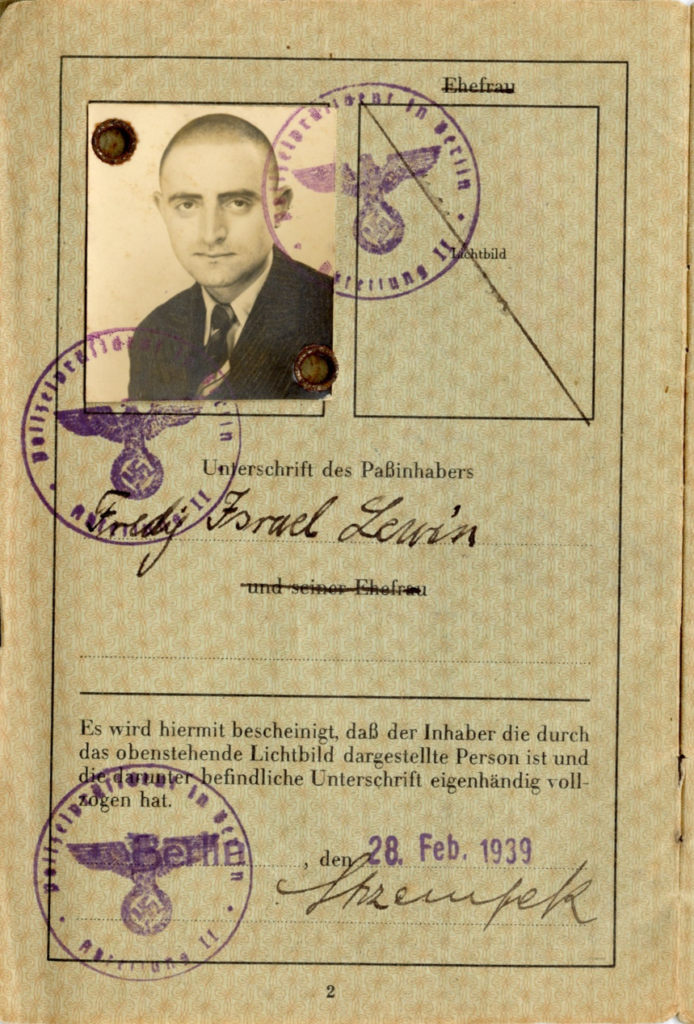
Beginning in January 1939, Jewish men were required to add the name Israel to their official documents. Jewish women were mandated to add the name Sara.
Born in Berlin, Fredy was 25 and working as a salesman at the time of his arrest. According to a note in the collection from a cousin, he was “caught being a homosexual.”
Fredy’s paper trail though, is less clear, and reveals some of the challenges of these primary documents—and of navigating the often arbitrary designations of the Nazi bureaucracy used in these documents. Often those arrested under the infamous Paragraph 175 of the German Criminal Code, which criminalized sexual acts (or even suspected sexual desire) between men, would have the designation “¶ 175” or “homo” on their arrest record. Fredy did not.
According to a document in the Arolsen Archives, Fredy’s prisoner number classified him as an “antisocial,” presumably meaning that he was arrested as part of Operation Work-shy. But an earlier designation, crossed out in the Arolsen document, labeled Fredy as a career criminal, which was sometimes applied to those who had been previously arrested at some point. Jews picked up in the June Action were, at least initially, supposedly those with prior convictions. Finally, the document describes Fredy simply as a Jew.
Fredy may have been arrested for any of these supposed transgressions, all of them, or perhaps none. Perhaps even Fredy did not know.
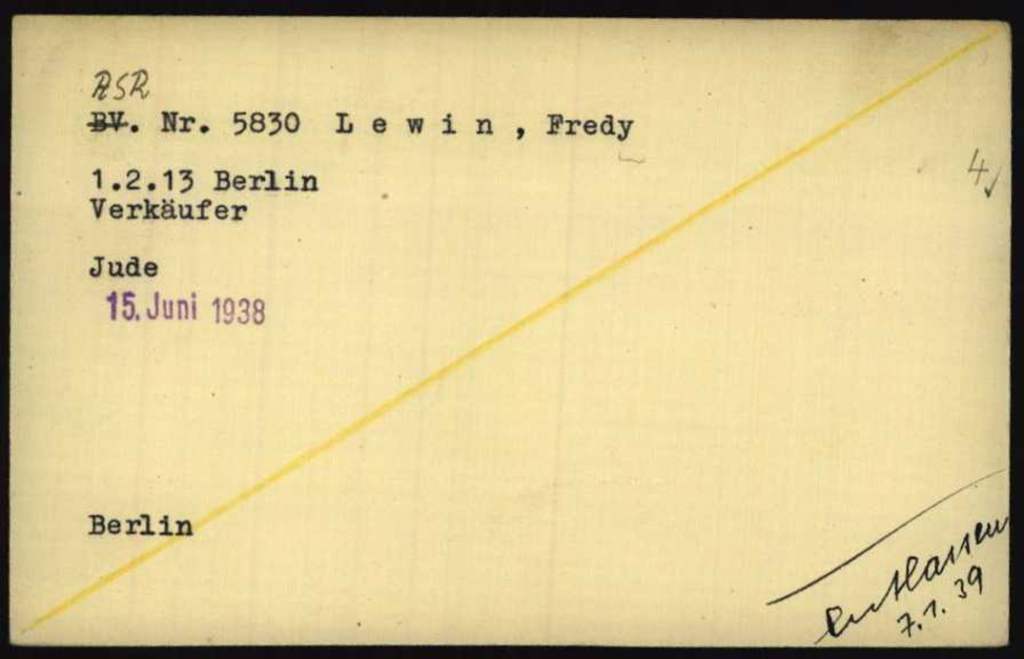
https://collections.arolsen-archives.org/en/search/topic/1-1-5-3_01010503-001-297-395?s=Fredy%20Lewin
Again, according to the collection’s donor, Fredy’s mother bribed a guard to get him out of Buchenwald. He was released on January 7, 1939, and by April was on a ship bound from Italy to the relative safety of Shanghai, a city that, because it did not require visas, attracted about 20,000 Jewish refugees at the time. Fredy took up tailoring in Shanghai, a trade that he continued when he finally was able to immigrate to San Francisco in 1948. For many years he owned Freddy’s Dressmaking and Tailoring shop in various locations in the city. He passed away on May 6, 1995.